PMR-2026-0716-USA-001 · Capture & Procurement
An assessment of when a federal competition is actually decided, what the public record already says about any competitive field before a solicitation publishes, and the capture-intelligence baseline a pursuit team should hold before it commits bid-and-proposal money. Written for teams that sell into government markets and for the executives who approve their pursuit budgets.
Read the full PMR (PDF) →Durable read · Update Addendum on final-rule issuance in the FAR overhaul's competition-relevant parts or a material change in published competition data
Key Judgments
Six judgments anchor this assessment. Each is tied to cited evidence in the body of the brief and carries an explicit confidence level.
- High confidence. The decisive phase of a federal competition precedes the solicitation. GAO's own finding on defense competition locates the fix in the acquisition-planning phase, before a solicitation ever issues, because that is where requirements are shaped and where incumbent advantage hardens into single-offer outcomes.
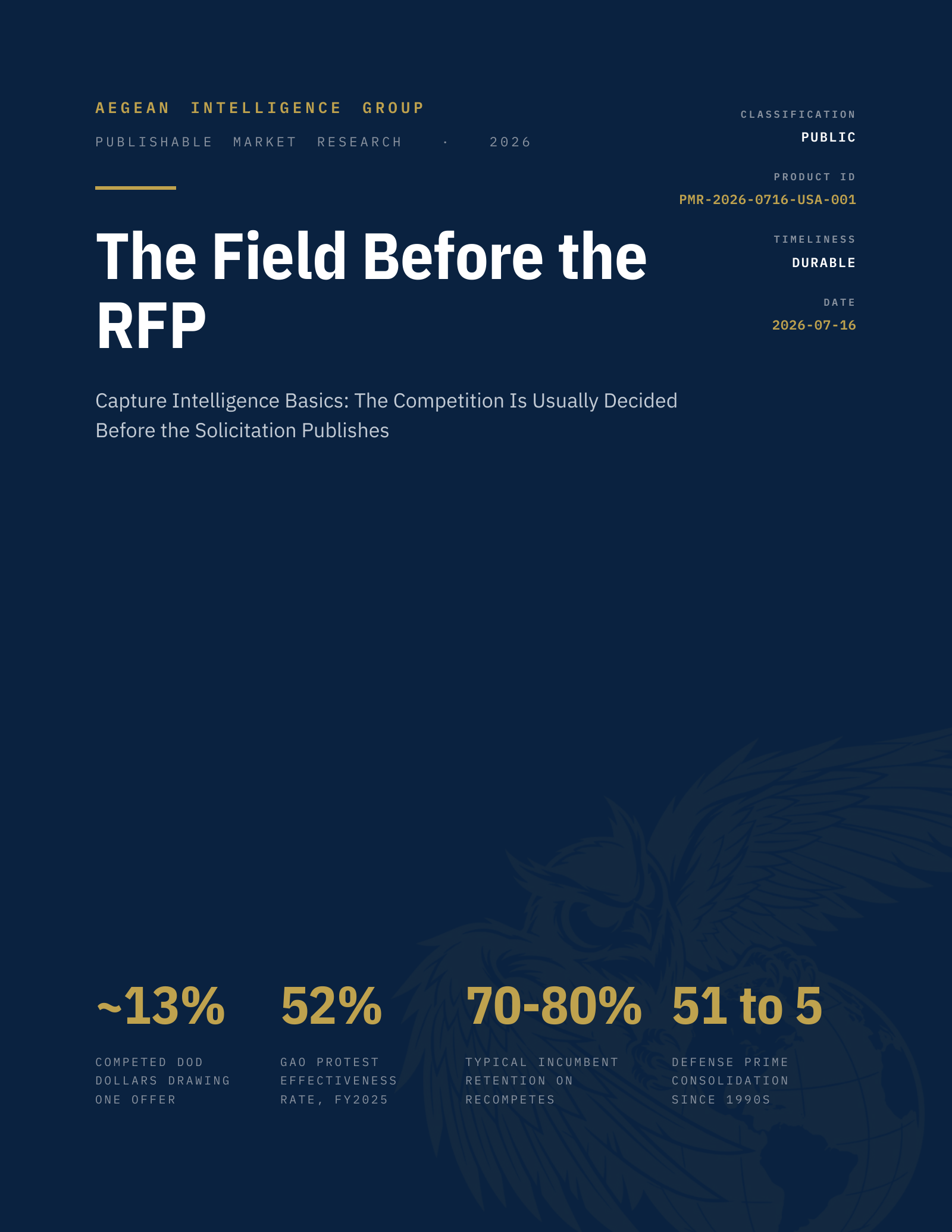
- High confidence. A pre-decided field leaves a measurable signature in public data. Roughly 13 percent of DoD competed obligations drew exactly one offer in the last year GAO examined closely, 69 percent of non-competitive exceptions cite "only one responsible source," and the DoD competition rate has averaged 54.2 percent over a decade against a consolidated base of five primes.
- High confidence. The field is reconstructable from public instruments alone. Award history and expiring contracts (FPDS and USAspending), pre-solicitation activity (SAM.gov sources sought, RFIs, industry days), agency long-range forecasts, and GAO protest dockets together support a working map of buyer, incumbent, and likely field with no proprietary access.
- Moderate confidence. Incumbency is an advantage, not a verdict. Industry analyses of federal award data put incumbent retention on recompetes at roughly 70 to 80 percent, dropping materially where performance problems are documented; the counter-UAS market's rapid new-entrant awards show that structurally open fields do get taken. Confidence is moderate because retention figures are vendor-analyzed rather than government-published.
- High confidence. The protest docket is a field-read delivered too late. FY2025's 52 percent effectiveness rate shows agency evaluation records are often defective, but the leading sustain grounds, unreasonable technical and cost evaluations and unreasonable proposal rejection, describe failures a capture-phase read of the buyer's history and evaluation habits would have priced in before bid.
- High confidence. The operative decision is bid discipline. A standing capture-intelligence baseline, the expiry calendar, incumbent map, buyer history, and field structure, held before the RFP, converts the bid or no-bid call from instinct to evidence. A pursuit entered at solicitation, with no prior field read, competes against teams that have been shaping the outcome for a year.