Aegean Intelligence Group
THE AEGEAN REGISTER / AIG-GOV-26-013AIG-GOV-26-013 · PUBLIC RELEASE · 2026
ReportAIG-GOV-26-013Political Risk & GovernanceCreated 2026-11-03Updated 2026-11-03Standard: AEGEAN-OS v1.3
POLITICAL RISK & GOVERNANCE · ASSESSMENT · CURRENT

Deadlines that will slip and incumbents who will hold: three political-risk calls for December

Israel's coalition clock, The Gambia's third-term vote and South Sudan's first election

December carries three political deadlines, and the calendar flatters all of them: Israel will not have a new government by the time the first mandate runs out, The Gambia's incumbent is more likely than not to win a third term against a split opposition, and South Sudan's first national vote is more likely to slip or shrink than to open on the day set.
THE DOCUMENT
NumberAIG-GOV-26-013
Product IDPMR-2026-1103-GLB-013
ProductAssessment
Issued2026-11-03
Pages18
DistributionPublic release
TimelinessCURRENT
DOWNLOAD
FULL PUBLICATION (PDF)
18 PAGES · 0.5 MB · FREE
HOW TO CITE

Aegean Intelligence Group, “Deadlines that will slip and incumbents who will hold: three political-risk calls for December,” AIG-GOV-26-013, The Aegean Register, 3 November 2026.

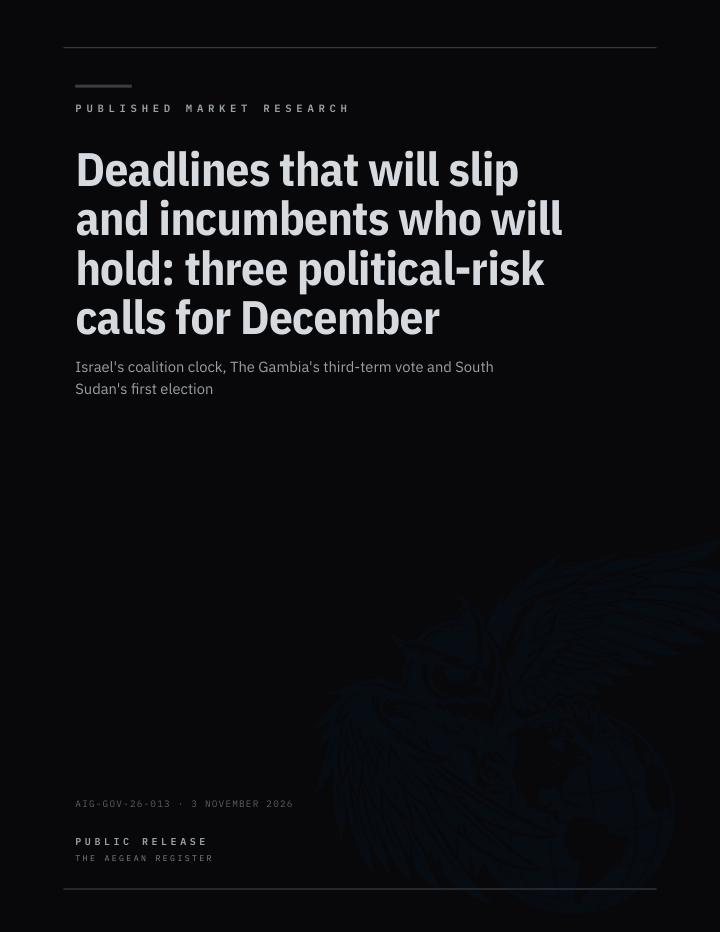
Deadlines that will slip and incumbents who will hold: three political-risk calls for December cover
Cover
On the record

1 calls from this report, among 41 in Political Risk & Governance.

Each line is one call in the domain, from the day it was written to the day it resolves. This report's calls are lit; point at any line to read it.

FORWARD CLAIMS · DATED TO PUBLICATION · SCORED ON THE SCORECARD →
IDStatementpMade onResolves byStatusOutcome
CLM-2026-471A new Israeli government wins a Knesset confidence vote on or before 22 December 2026.0.152026-11-032026-12-22Locked

A claim is entered in the brief's own words and carries its publication date and the day it entered the ledger: the register's briefs on 8 September 2026, when the standard was first applied; the forward benchmark on the day it was locked. It resolves only against a dated public source. The scoring rule is on the Methodology page.

THE CENTRAL JUDGMENT
KEY JUDGMENTS
Bottom line

The three December calls share one pattern: deadlines written into law or announced by governments will slip where the arithmetic or the logistics do not support them, while an incumbent who controls the state and faces a divided field will hold. Israel's coalition arithmetic gives neither camp a working majority without parties each has ruled out, and the minority route that a simple-majority confidence vote allows still runs through those same red lines, so the formal clock will be used to the full. South Sudan's ruling party wants a vote on the day set, but the conditions for a nationwide poll are absent, so the likelier outcome is a late postponement, and the costlier ones are a narrow vote that the opposition rejects or a postponement with no new timetable. In The Gambia the opposite holds: Barrow cleared a majority last time, and a fragmented opposition makes a repeat more likely than not.

KJ-01No new Israeli government will win a Knesset confidence vote before the first candidate's full period runs out in late December. The fastest path on paper is a minority government that wins by a simple majority with Ra'am voting for it and the Joint List abstaining, but it needs Yisrael Beiteinu and most of the opposition to drop their objections to relying on an Arab-led party within weeks, and in the 2021 precedent the same kind of coalition took a second mandate and close to three months. The arithmetic of that path exists, but every leg of it requires a stated red line to fall, and most Israeli formations read on the firm's list took longer than the time this call allows.MODERATE
KJ-02Whoever the president assigns first, the recommendations he receives will not translate into a governing majority, because a lead for Eisenkot depends on Arab-led parties he has not agreed to bring into government and a lead for Netanyahu depends on a bloc that is short of a majority. The assignment itself falls after this paper's reading date and is left open rather than forecast. Recommending a candidate is not joining or sustaining a government, and the only report of how the Arab-led parties will recommend comes from a source off the firm's list.LOW
KJ-03Adama Barrow is more likely than not to be declared the winner of The Gambia's presidential election, unless the opposition consolidates behind one challenger, formally as in the coalition that unseated Yahya Jammeh or in practice if Talib Ahmed Bensouda is ruled ineligible and his voters move to Ousainou Darboe. Barrow won an outright majority in the previous election, so he would have won that year even against a combined opposition, and the opposition is now split across rival alliances, which outweighs the anger over blackouts. The outright majority last time carries the judgment more than the plurality rule does, though the evidence for the current split comes only from local sources off the firm's list.MODERATE
KJ-04South Sudan is unlikely to open a nationwide vote on the day set, while a narrow, stage-managed vote in the areas the government controls remains a real path, and that narrower outcome is the one this paper's claim scores. The voter roll and census are missing, the president has dissolved the transitional unity government formed under the peace agreement and the main opposition leader is on trial, while the amended election law and the presidency's insistence on the date keep a partial poll alive. Crisis Group gives the same two outcomes, and no source read shows the electoral commission funded and equipped for a nationwide poll.MODERATE
KJ-05Measured by severity rather than likelihood, a narrow South Sudanese vote on the day set would do more harm than a clean postponement announced with a new timetable, and about as much harm as a late postponement with no timetable, which is the likelier outcome. A narrow vote hands the ruling party a mandate the opposition has already rejected, while an open-ended postponement extends an unelected transition with no power-sharing and the main opposition leader on trial. A United Nations human rights commission has warned that elections without a strategy for democratic consolidation and for preventing national schisms could fuel renewed conflict and atrocities, and the main opposition alliance has already rejected the amended law under which such a vote would run.LOW
SOURCES AND LIMITS

Open-source intelligence current through 3 November 2026. The publication carries a 22-entry source registry, explicit confidence tags, limitations, and deterministic resolution rules for its forward claims.

SOURCE REGISTRY: 22 ENTRIES18 PAGESTIMELINESS: CURRENT

The source tiers, estimative language, forward-claim rule, scoring, and corrections record are public on the Methodology page.

Connected objects
Claims (1)
Desk (1)
Series a claim resolves against (0)

No claim on this report names a series the Dashboard carries.