
H1
Managed erosion
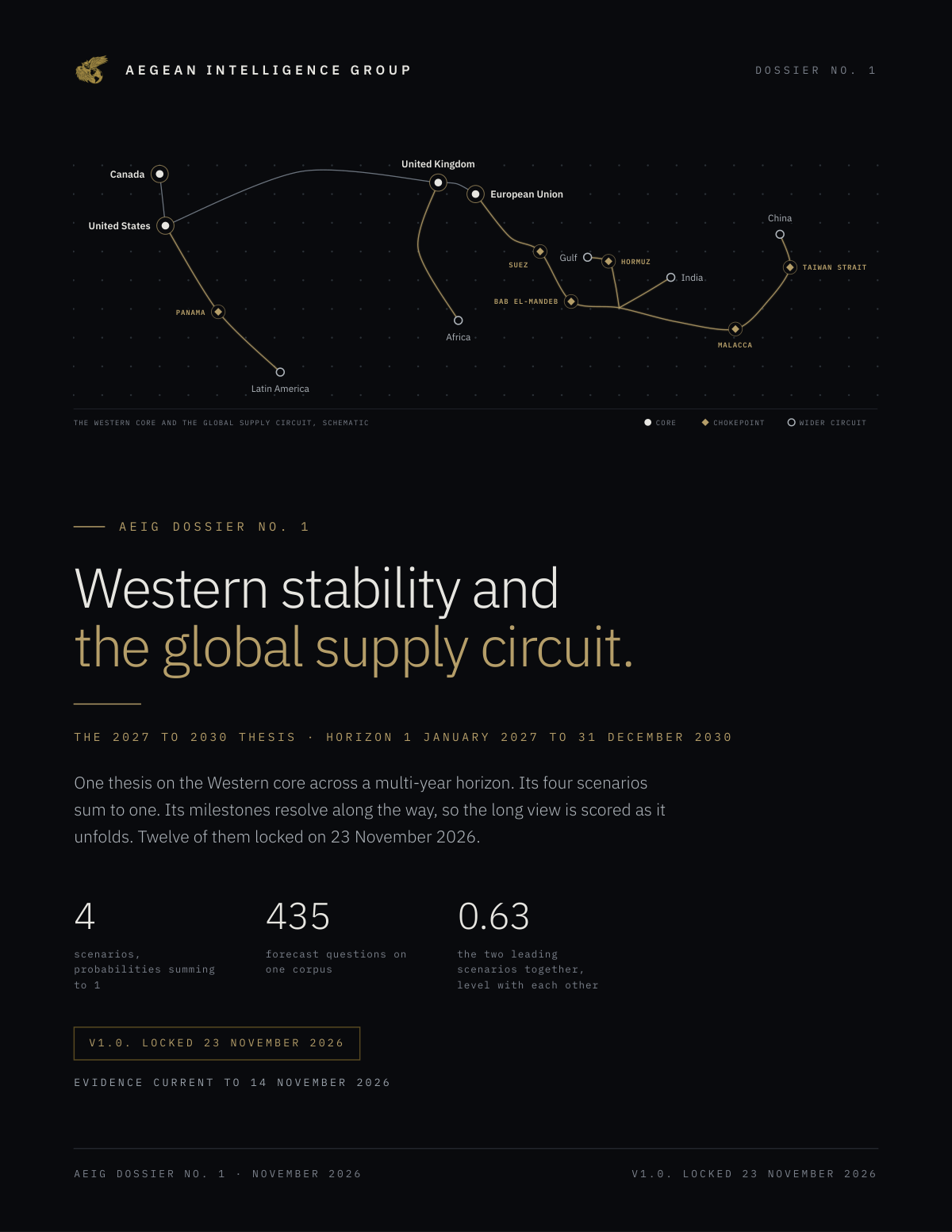
Whether the governing and economic capacity of the Western core holds, erodes or fractures from 1 January 2027 to 31 December 2030, and how each path travels through the global supply circuit to the rest of the world.
The thesis and the scenarios it chooses between. The scenarios are exhaustive and exclusive, and their probabilities sum to one.
From 2027 to 2030 the Western core is about as likely to split into trade and security blocs as to erode under a strain its institutions absorb.
Read on Separates H2: a Yes lifts H2 from 0.19 to 0.50; a No trims it to 0.14; French linked group. M01
Read on Leans to H2: a Yes lifts H2 from 0.19 to 0.27 and trims H4 to 0.12; a No trims H2 to 0.15; French linked group. M02
Read on Separates H2: a Yes lifts H2 from 0.19 to 0.52; a No trims it to 0.15. M05
Read on Separates H2: a Yes lifts H2 from 0.19 to 0.33; a No trims it to 0.15; the H1 timeline still holds a French censure in 2028; French linked group. M06
Read on Leans to H4: a Yes lifts H4 from 0.18 to 0.24; a No cuts H4 to 0.10 and lifts H2 to 0.24. M07
Read on Leans to H2: a Yes lifts H2 from 0.19 to 0.29; a No trims it to 0.16; under the rule a debated objection meets H2 only beside a central bank purchase within six months. M08
Read on Separates H2, most of all on its No: a Yes lifts H2 from 0.19 to 0.55; a No cuts it to 0.03; a Yes through a central bank purchase alone stays in H1. M11
Read on Separates H2 by a narrow margin: a Yes lifts H2 from 0.19 to 0.30; a No trims it to 0.15; French linked group. M12
Read on Separates H4: a Yes lifts H4 from 0.18 to 0.32; a No trims it to 0.14. M13
Read on Separates H4 on its No: a No lifts H4 from 0.18 to 0.31 and trims H2 to 0.11; a Yes cuts H4 to 0.06 and fits H1, H2 and H3 alike. M14
Read on Separates H3 from H1 and H4: a Yes lifts H3 from 0.31 to 0.72; a No trims it to 0.23; under the rule an act inside a crunch counts as H2. M15
Read on Base-case check: neither outcome moves any scenario by more than 4 points; the class puts an episode near even. M16
Each has a window, a resolution rule and a primary source. Select a milestone to read its rule.
The red team raised 23 findings. Its reviewers wrote none of the draft.
Every finding is below, with how it was answered.
H2 is printed at 0.21, below two of its own triggers on the panel's means: the broad sovereign stress question (C-25) at 0.317 and a debated electoral objection (C-17) at 0.234. Either alone resolves H2 under the proposed decision rule.
How it was answered:The rule now needs a strict funding break, a core annulment, or a debated objection paired with a purchase for the same country within six months. A purchase alone or an objection alone stays in H1. Round 2 printed both values: 0.464 on the first draft's tests and 0.190 on the revised rule.
The rule's H2 test is labeled the strict reading of the stress class but lists central bank purchases, which belong to the broad reading. On the classes' own dated members, the H2 tests held in 22 of 53 rolling windows since 1970 and in 14 of the 23 that start from 2000.
How it was answered:The funding test now reads rules A and B. The full rule is backtested on every window from 1970: 12 of 53 windows in H2, 8 in H3 and 33 in H1 or H4, reproduced by the second red team. The question set's label fix is owed at the lock.
The 0.48 floor for H1 and H4 is built partly from the involuntary ending class, which the rule does not use. On the panel's own trigger means and independence, H1 and H4 together come to about 0.19 to 0.32, and 0.58 needs triggers whose means sum to about 1.0 to overlap into a union of 0.42.
How it was answered:The anchor now uses strict stress and alliance strain, states their correlation and prints the panel's direct 0.496. The printed product still pairs the all-member alliance rate (22.7 percent) with a record that counts core members; on the core-only rate the product is 0.650, not 0.60. (red team: partly)
The H1 and H4 narratives assume Hormuz reopens in stages through 2027, while the supply chapter's desk estimate puts a 300-transit week by 31 March 2027 at 0.15 and the 80 percent line at 0.076. The likeliest Hormuz reading is the one the Dossier says lowers H1 and H4, and H1's own Hormuz signpost holds with a chance of about 0.08 at most.
How it was answered:H1 is written for a strait near closed through 2027. H4 carries an explicit closed-strait branch. The Hormuz signposts are restated with expected updates near zero, and the 80 percent claim is printed as a base-case check.
H3's supply test rests on a question no chapter forecasts (Hormuz and Bab el-Mandeb below 70 percent of 2023 traffic at the end of 2027), which present readings make likely, on a 2023 baseline where every other Hormuz line uses 2025. Its supply readings and the USMCA question close by 2027 or 2028, so a split that starts in 2029 or 2030 counts only through two questions.
How it was answered:The two-strait reading is rebased to 2025, read at four year ends and forecast at 0.304. The USMCA and mineral windows run to 2030. The consequences for H3 and the Hormuz line's season are taken up in RT-15 and RT-17.
H4's two-of-three test passes on defense spending and world growth with German output below its 2024 level, the combination six personas call H1. World growth does not measure the core, and any single H2 or H3 trigger, a liquidity operation included, erases H4.
How it was answered:Core output replaces world growth, and an output reading is required among the two that pass. The panel put core output at 0.261 and two of three readings at 0.309.
Several headline milestones do not separate the scenarios they are said to move. The chapters treat three or more recessions, two unrelated government endings and the NATO spending pass as consistent with H1, while the milestone table reads a Yes on C-31 and C-26 as H2 and a No on C-19 as H1.
How it was answered:Directions for the 16 headline candidates now come from the panel's chance of a Yes under each scenario. C-05 and C-36 are labeled base-case checks. The C-32 floors are taken up in RT-22.
Key judgments rest on facts still marked to verify: the NATO table behind a HIGH judgment and the highest-mean milestone, the truce dates behind the first calendar pivot, the contested-election class behind half of H2's rule, the alliance and USMCA reports behind H3, and the world growth figures behind H4's third test.
How it was answered:The NATO table, world growth, the X-date and the Pew line are confirmed. The facts behind H3 remain open: the troop cut and Greenland on press reports, the Article 5 remark and brigade cut unconfirmed, the 1986 ANZUS act on pages not yet confirmed. The Chinese side of the truce date conflicts with the tier 1 record (RT-19). (red team: partly) The 1986 ANZUS suspension has since been confirmed on the State Department historian's page.
Numbers disagree between chapters: the synchronized recession base rate (0.62 by onsets against 0.53 by economy, the count that matches C-31's wording), the conditioning rerun (0.15 against 0.10), France's 2023 arrests (above 3,300, 3,505 and 3,554), the debt-limit room (717 against 694 billion dollars) and France's spot spread (150 against 153).
How it was answered:The spread (146), the arrests (3,554), the debt-limit room ($694 billion on 12 November) and the rerun (0.10) now agree. The milestone chapter and Part I give C-31 the 3.5-year rate of 0.472, while the economic and fiscal chapters still treat 0.53 as the matching rate. (red team: partly)
One fact id carries different sources and tiers in different chapters. The French 2023 arrests note is tier 1 in two chapters and tier 3 in the milestone table, and the Japan holdings note is confirmed in one chapter and to verify in another.
How it was answered:Each fact now prints one endnote, built from our record. The second red team checked the built draft: the NATO and French arrests notes print one source and tier each.
The same French cabinet risk enters the censure claim, the two-endings claim, the disorder-ending claim and the H2 narrative. The cohesion chapter reads most of the disorder-ending claim as French cabinet risk with no causal tie to disorder.
How it was answered:The French group is one bet in scoring. C-37 stays out of the headline set unless redrawn outside France. The panel's French share of H2 (mean 0.339) and its H2 with the group at No (mean 0.121) are printed nowhere, and the group's tie to an alliance act through a French presidency is not named. (red team: partly)
The panel's near-term departures from class rates all lean toward stress and draw on one year: censure at 0.261 against 5.6 percent, two endings at 0.293 against 0.193, and the term premium at 0.377 on a line unbroken in nearly 12 years.
How it was answered:Round 2 applied the rule. C-12 fell to 0.217 with named readings. C-26 and C-31 sit within 10 points of their classes. C-32 and C-38 moved down, so the departures no longer lean one way.
The conditioning test's null holds the unconditional rates steady, though the chapters say it could not detect a doubling of a rate and the present phase lies outside its sample.
How it was answered:Part II prints the doubled case with the panel's own doubled forecasts: H2 at 0.329 and H3 at 0.349. Its alliance figure should follow the class chosen for C-32 (RT-18).
Some claims can resolve on data from before their window or on lines and measures not yet fixed: the Japan holdings claim on 2026 month ends, the trust claim on an unconfirmed 2010 Pew figure, and the wage claim on two versions of its proxy.
How it was answered:Eight claims are redrawn and a resolution rule admits only in-window periods. Part IV's dollar signpost and the spillover chapter's Japan judgment keep the old wording, C-06's controls are not yet named, Poland's measure is unfixed and the question set's redrafts are owed. (red team: partly)
The revised H3 rule scores events its narrative does not describe. On the record its only H3 windows hold the 1986 ANZUS suspension and the 2020 EU exit (8 of 53). On the panel's components, worlds with one trigger alone make up 78 percent of H3's trigger worlds. The commonest single event, an alliance act, is forecast at its class rate.
How it was answered:Rename and rewrite H3 to say what the rule scores, or narrow the rule to the split the narrative describes (for example, two trigger families or a Taiwan quarantine alone), and forecast both versions side by side before the lock.
The Thesis sentence says the core is about as likely to split into trade and security blocs as to erode. Round 2 priced the rule's H3, which a redefinition moved. Part I places H3's departure in the supply circuit, while the record's H3 holds no supply reading and the formal acts carry 0.35 against the split's 0.19.
How it was answered:Rewrite the Thesis sentence and Part I's key judgments to name the rule's event and the cause of the move, and place the departure in the formal acts as well as the supply circuit. Follow any narrowed rule.
The two-strait reading's Hormuz line (59.9 a day) sits above an ordinary winter: December 2025 ran 55.5 and January 2026 58.5, both before the war. Read on 31 December, the reading reduces to a further fall at Bab el-Mandeb from a 2025 base already inside the Red Sea episode.
How it was answered:Read Hormuz against the same month of 2025 or on an annual or 90-day mean, or require each strait below its line in every month. Forecast the corrected reading and move the supply split and H3 with it.
C-32 counts acts by core members but is scored against the 22.7 percent class, which includes Greece in 1974 and Turkey in 1975. Acts by core members give 16.0 percent. The choice flips the sign of the panel's skill at 0.174.
How it was answered:Resolved by the Principals' ruling at the lock. C-32's reference forecast is 16.0 percent: acts by core members only, 12 of 75 windows. The all-member class rate of 22.7 percent is printed beside it. Its probability of 0.17 is unchanged. The 1986 ANZUS suspension has since been confirmed on the State Department historian's page.
The mineral reading's starting state is unknown. The tier 1 record shows No. 70's suspension running to 10 November 2026 and an extension of No. 21 only; the 10 January 2027 date for China rests on a tier 3 report. A silent lapse before the window would leave C-06 and the H3 supply reading unable to resolve Yes.
How it was answered:Held back from the lock by the Principals' ruling. The controls are not yet named by their Ministry of Commerce announcement numbers. C-06 stays proposed until its settling source is cleared.
Two resolution rules conflict. The front matter and the milestone chapter say a claim resolves on the reading first published within its window; the conventions list and every milestone row say after its window closes. C-13, C-18 and C-20 fix publication dates after their data periods.
How it was answered:Resolved by the Principals' ruling at the lock. A claim resolves on the reading first published after its window closes. The front matter, the milestone chapter, the conventions list, the Method chapter and the glossary now print that rule. A claim that names another reading keeps it.
Numbers left from round 1: the conventions list prints first-round means (0.413, 0.210, 0.210, 0.167); the cover gives 0.32 for both leading scenarios though H3 rounds to 0.31; the milestone chapter still leads its early tests with Hormuz; the glossary defines round 2 as a round on wide items only.
How it was answered:Bring each to the round 2 values and to Bab el-Mandeb as the lead supply signpost.
C-32's chance of a Yes under H1 and H4 is zero under the rule, but the milestone chapter prints 0.03, the scale's floor. With zeros C-32 comes to 0.165 and a Yes lifts H3 to 0.78. Part IV also calls the seven personas independent, while the milestone chapter says they share one body of evidence.
How it was answered:Allow zero where the rule forces it and print the coherent values and moves. Drop "independent" from Part IV's key judgment.
The constitutional test counts an election annulled in whole or in part, and its question counts a court-ordered rerun. A rerun for one seat would meet it literally. The record's count and the panel's 0.034 read national annulments only.
How it was answered:State at the lock whether a seat-level annulment or rerun counts, and limit the test to a nationwide result, the presidency or the chamber's composition if it does not.
Every Dossier begins with what usually happens in a window of this length. The thesis is written only after the base case, and must say where it departs from it and why.
Reference classes set out by rules fixed before any member was counted.
Chapters on the present state of the field, each fact sourced.
A panel of 7, each working under one assigned method.
23 red team findings. Its reviewers wrote none of the draft.
The Principals approve the probabilities. The milestones go on the append-only ledger before the horizon opens.
Every source, reference class, scenario, rule and red team finding. The full Dossier is free. It is sent by email from the form on its page, so a copy always comes from us.
Compare the file you received by email with the fingerprint held on the record. Version 1.0, 11.0 MB.
Every milestone is graded against the source named in its rule, on the probability locked at the press. The ones that go against us stay on the record beside the ones that do not.
Each resolved milestone is scored on the Brier rule: the squared distance between the locked probability and what happened. Lower is better.
A later probability never replaces the locked one.
Each claim resolves on the reading first published in its window. If the primary source stops, the fallback settles it, and the switch is a dated entry with its reason.
A claim that neither source can settle is flagged for a Principal and recorded as unresolved with its reason. It is not scored. A void claim is listed as void and is not scored.
The ledger is append-only. A correction is a new dated entry that names the one it corrects.
How the set is scored if a test is void is fixed before the lock.
An ordinary claim on the firm's track record. It is graded and counted like any other call.
Listed on its own, apart from the headline score. Nothing on that list is counted into it.